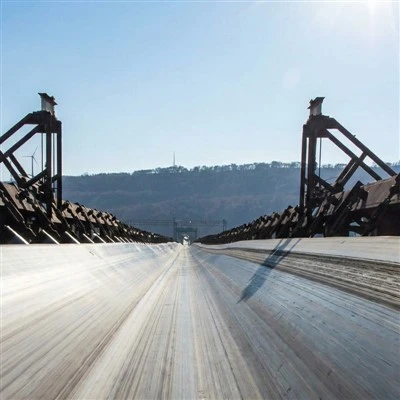
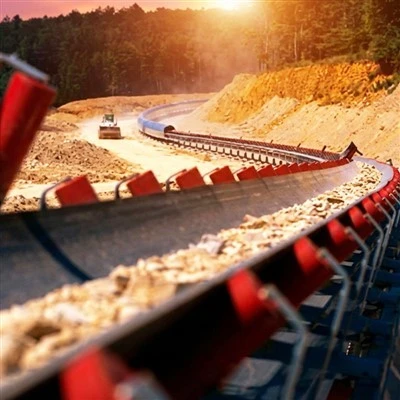
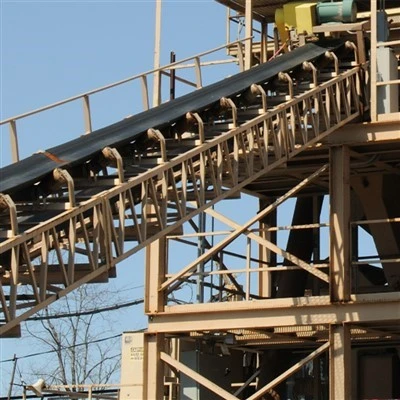
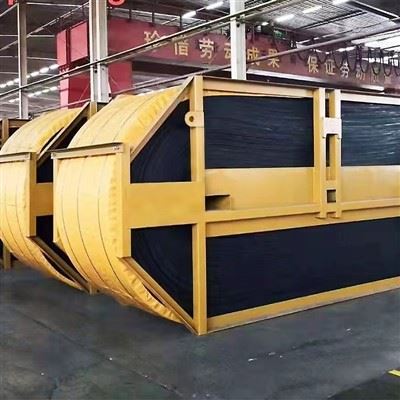
The rubber conveyor belt is the core component of a belt conveyor. Its working principle is based on friction drive. An electric motor drives a drive drum, utilizing the friction between the drum and the conveyor belt to continuously move the belt and materials.
Core Working Principle
- Power Transmission: The electric motor drives the drive drum to rotate through a reducer.
- Friction Drive: Friction is generated at the contact surface between the drive drum and the rubber conveyor belt, driving the conveyor belt to move continuously.
- Material Loading: The material is evenly spread on the conveyor belt and travels with the belt to the discharge end.
- Closed-Loop Operation: The conveyor belt loops around the drive drum and the idler drum, forming an endless loop. The upper layer is the load-bearing section (material transport), and the lower layer is the empty return section.
Key Structural Components
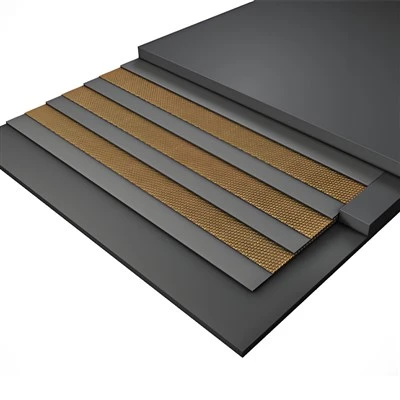
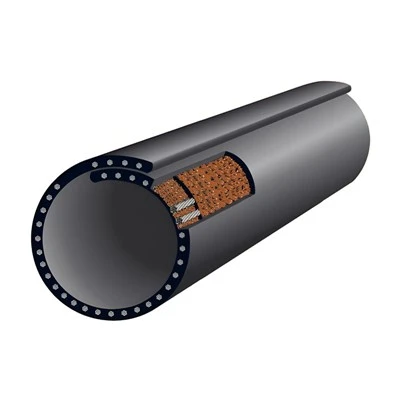
- Conveyor Belt: Composed of a cover rubber layer, a skeleton layer (canvas/steel wire rope), and a core rubber layer, it has both load-bearing and traction functions.
- Idler rollers: Support the conveyor belt and reduce running resistance; include trough idlers (carrying section) and flat idlers (return section).
- Tensioning device: Maintains proper tension on the conveyor belt to prevent slippage or sagging.
- Drive unit: Includes motor, reducer, and drive roller; it is the power source.
- Idler roller: Changes the direction of the conveyor belt; usually located at the tail end.
Applicable Scenarios and Characteristics
- Applicable materials: Lump, powder, granular, and packaged goods (such as coal, ore, sand, gravel, grain, etc.).
- Advantages: High transport capacity and efficiency; simple structure and stable operation; low energy consumption, low noise, and low dust; capable of long-distance (tens of kilometers) and large-angle (requires special design) conveying.
- Limitations: Not suitable for conveying sharp, high-temperature (>60℃ with conventional belts) or highly corrosive materials (requires special heat-resistant/acid-alkali-resistant belts); high initial investment and high installation precision requirements.
- Typical application industries: Heavy industries such as coal mining, metallurgy, power, ports, cement, chemicals, building materials, and grain storage.