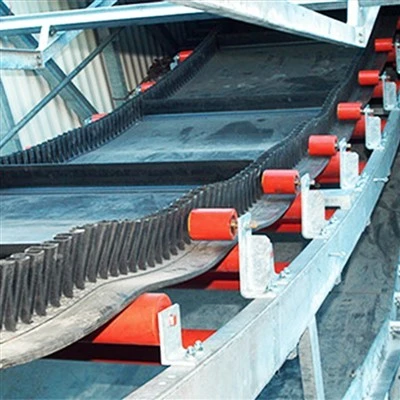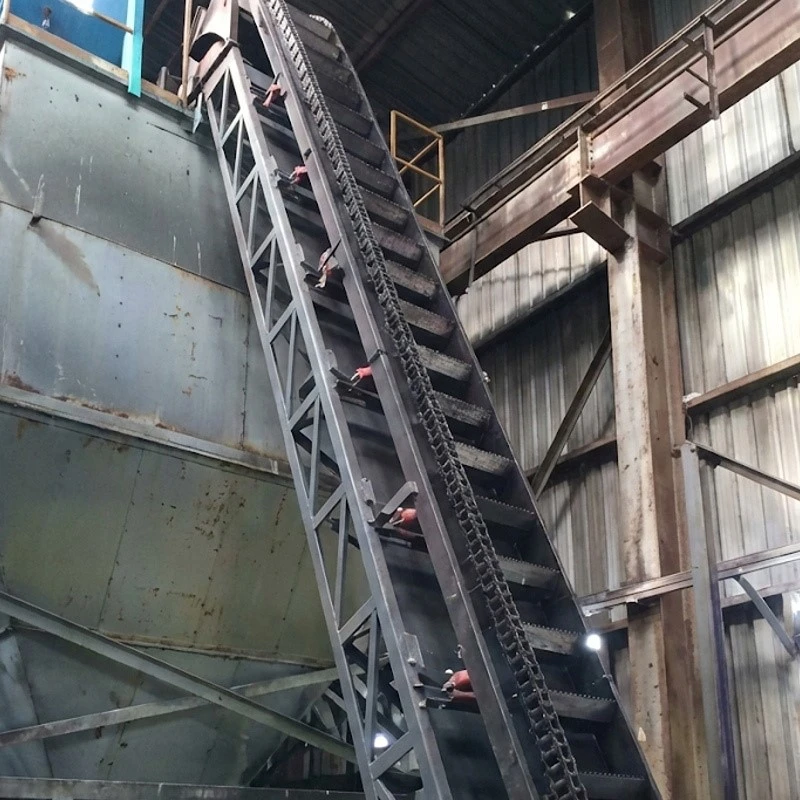
Sidewall conveyor belts, also known as steep angle corrugated sidewall conveyor belts or skirted partition or cleated conveyor belts, are a type of specialized conveyor belt designed to address steep angle and vertical conveying applications. They are widely used in scenarios involving the continuous conveying of bulk materials at steep angles. These belts can operate stably within any angle range from 0° to 90°, achieving dual breakthroughs in conveying inclination and space utilization. They are particularly suitable for steep angle and vertical lifting conditions where traditional conveyor belts fall short.
The steep angle corrugated sidewall conveyor belt consists of three components: the base belt, sidewalls, and cross-ribs. The sidewalls are designed with a corrugated profile, while the cross-ribs feature T-shaped, C-shaped, or TC-shaped structures. The sidewalls and cross-ribs are bonded to the base belt through a secondary vulcanization process, ensuring high bonding strength.
Wide width sidewall conveyor belts are precision-engineered from three main components: the base belt, corrugated sidewalls, and cleats. This unique three-part structure forms a "box-shaped" conveying space, ensuring stable and controlled material transport during high-angle conveying.
The cleat is mounted vertically between the base belt and the side walls, forming a separate "pocket"-shaped compartment that supports the material; it is a key component for achieving high-angle conveying. The selection of the crossbar is determined by the conveying angle.

|
Cleat Types |
Applicable inclination angle |
Application Features |
|
T Shape |
18°~40° |
Suitable for conveying at small to medium angles of inclination, with low cleat height |
|
C Shape |
40°~60° |
Suitable for steep angle conveying, with superior material transportation capacity |
|
TC Shape |
60°~90° |
Suitable for extremely steep inclines and vertical conveying, as well as applications where the material being conveyed has good flowability |
|
Without cleat |
Below 18° |
In situations where the slope is gentle and materials are easy to transport, only sidewall is needed, the cleat can be moved. |
|
Based on the characteristics of your material and your specific conveying requirements, we can help to design the appropriate sidewall and cleat. |
||
Corrugated sidewalls are located on both sides of the base belt and are designed with a corrugated profile to facilitate wrapping around the drum. The primary function of the sidewalls is to prevent material from slipping and spilling out from the sides during conveyance. The height of the sidewalls can be flexibly selected from 40 mm to 630 mm based on the characteristics of the conveyed material and the conveying capacity.
Major Technical Advantages and Application
Our steep-angle sidewall conveyor belts have been widely adopted and used in various industries worldwide, including mining, cement and steel.
- Large conveying angle and high space utilization
- Compact footprint, significantly reducing civil engineering costs
- Simple structure, low maintenance costs
- Smooth operation, low energy consumption
- Tear-resistant and impact-resistant, long service life
- High adaptability, comprehensive range of cover rubber options
- Wide conveying range, strong material compatibility
- Environmentally friendly sealing, controllable dust emissions
With its unique structural design, the steep-angle sidewall conveyor belt overcomes the dual limitations of traditional conveyor belts regarding incline angles and space utilization, providing a cost-effective and efficient technical solution for the high-angle and vertical conveyance of bulk materials. It has demonstrated exceptional value in a wide range of industries, including underground coal mining, ports and terminals, thermal power generation, metallurgy and steel, cement and building materials, and chemical and fertilizer production. As global industrial sectors continue to demand higher standards for space utilization, environmental compliance, and operational efficiency, the scope and depth of wide-width sidewall conveyor belt applications will continue to expand, offering a promising market outlook.
Choosing Steep angle sidewall conveyor belt means selecting a highly efficient solution for your material handling system that saves space, reduces energy consumption, and ensures stable operation.
Future technological trends for corrugated sidewall conveyor belts are primarily reflected in the following areas:
Greater Conveying Capacity
Moving toward ultra-wide belt widths (2,400 mm and above) and higher sidewalls (630 mm and above), with continuous improvements in single-unit conveying capacity.
01
Higher Temperature Resistance
Developing cover rubber formulations capable of withstanding higher temperatures to expand applications in the conveyance of high-temperature materials in the metallurgical industry.
02
Intelligent Monitoring
Integrating sensor technology to enable real-time monitoring and early warning of the operational status of sidewalls and cross-ribs.
03
Lightweighting and Energy Efficiency
Adopting new lightweight, high-strength reinforcement materials (such as aramid) to reduce the belt's self-weight and lower operational energy consumption.
04
Multi-functional Composites
Developing composite cover rubbers that combine multiple properties such as heat resistance, flame retardancy, abrasion resistance, and cold resistance.
05
Hot Tags: steep angle sidewall conveyor belt, China steep angle sidewall conveyor belt manufacturers, suppliers, factory, sidewall conveyor belt, Steep Angle Sidewall Conveyor Belt, Wide Sidewall Conveyor Belt