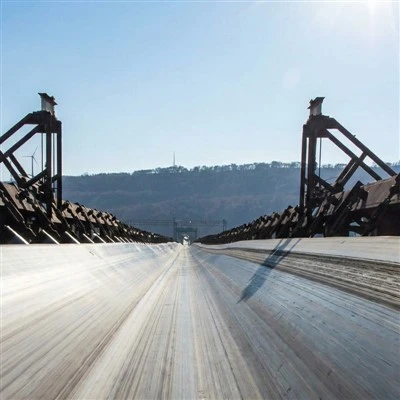
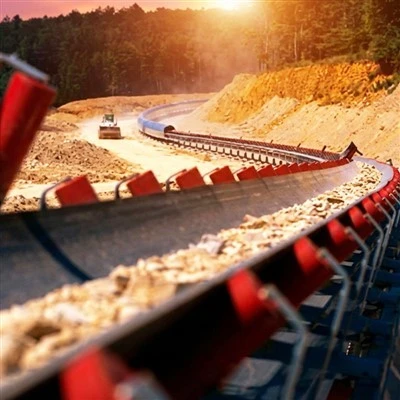
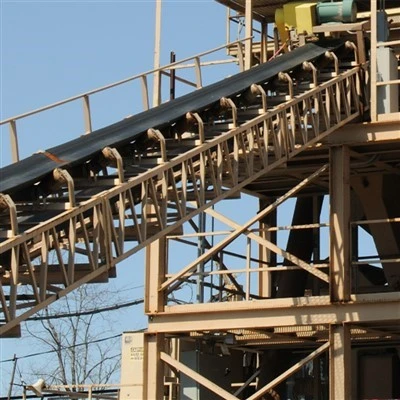
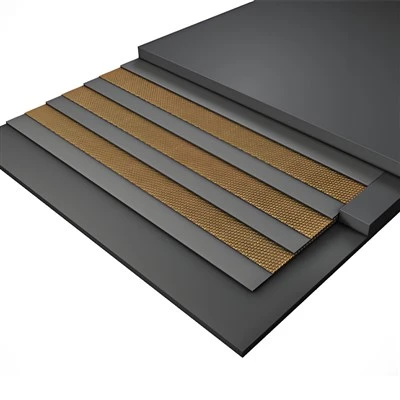
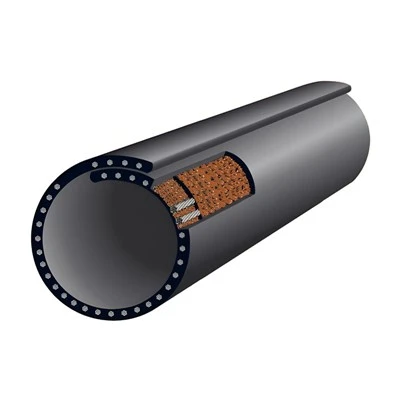
Aramid rubber conveyor belts are high-performance belts featuring an aramid fiber carcass combined with highly wear-resistant rubber covers. Widely used in heavy-duty and environmentally sensitive sectors like metallurgy, mining, ports, and power generation, they leverage the unique benefits of aramid materials to achieve efficient, lightweight, and low-energy operation based on the friction drive mechanism of belt conveyors.
Core Working Principles
① Friction Drive: An electric motor drives the pulley (drum), which uses friction between the pulley and the belt to move the endless belt continuously, thereby transporting materials.
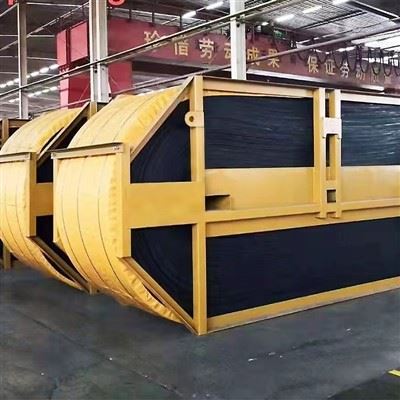
② Enclosed Conveying (Tubular Design): In tubular high-wear-resistant belts, the belt transitions from a flat shape into a U-shape, and finally rolls into a cylindrical tube. This completely encloses powdery or granular materials, preventing any dust leakage during transport.
③ Bi-directional Carrying: Unlike standard belts, tubular belt conveyors can be designed so that both directions serve as the carrying side, eliminating the empty return run and significantly boosting efficiency.
④ Reduced Rolling Resistance: Beyond basic friction drive, aramid fibers help improve the hysteresis properties of the bottom cover rubber. This significantly lowers indentation rolling resistance as the belt passes over idlers, further cutting down on drive power loss.
⑤ Minimal Elongation: Aramid fibers exhibit extremely low elongation under load (typically below 0.3%). This allows for tighter tension control over long distances, drastically reducing the need for frequent re-tensioning and ensuring absolute operational stability.
Key Roles of Aramid Materials
① Lightweight & Energy Saving: At equivalent strength levels, an aramid carcass is approximately 30% lighter than a steel cord carcass. This significantly reduces the required drive power, saving about 10% in energy consumption.
② High Strength & Impact Resistance: Aramid fibers boast high tensile strength, high modulus, and excellent impact resistance, making them ideal for harsh conditions involving large drops and sharp materials (such as ores).
③ Excellent High-Temperature Resistance: With a decomposition temperature exceeding 500°C and a continuous operating temperature of up to 300°C, aramid belts maintain exceptional strength and dimensional stability when conveying high-temperature materials like cement clinker or sinter.
④ High Safety Factor (Anti-Fatigue & Low Rebound): Aramid fibers have strong anti-fatigue properties. Crucially, in the unlikely event of a belt break, the kinetic energy released is over 30% lower than that of an equivalent steel cord belt. This greatly minimizes the risk of secondary damage to equipment and personnel.
⑤ Structural Optimization: The typical structure includes top/bottom covers, skim coats, and an aramid layer (often a straight warp woven fabric). To maximize performance, the aramid fabric is usually treated with RFL (Resorcinol-Formaldehyde-Latex) dipping or special adhesives (such as triethoxysilane systems) to significantly enhance inter-ply adhesion and prevent delamination under heavy loads.